2026
Natura Morta (Dead Life) essay for F issue 15: IN MEMORIAM
Essay published in F Magazine on stillness, still life, fascism, and the Death Drive
In 1910, at the age of 20, Giorgio Morandi took up residence
at the flat where he would reside until his death. Aside from
summer holidays and a wartime retreat to the family country’s
house in Grizzana, tucked away in the mountains on the
outskirts of Bologna, Morandi was content to move very
little. In 1956, less than a decade before his passing, he made
his sole trip beyond Italy’s borders: a journey to Winterthur,
Switzerland, to view a retrospective of his own work. While
in Swiss territory, he stopped in Zurich to visit an exhibition
of Cezanne…
2025
Sadaf Nava: Viridian Vapors Exhibition Text
There is no prison like a solid state. Distillation untethers matter, an alembic offering deliverance. The etymology of the word spirit is itself an ephemeral shapeshifter, a sort of transmutation. Grounded in air and breath, it ventured from its Latin origin, spirare to encompass essence, the supernatural, and two genres of substance: the divine (God) and the volatile (alchemy).
The alchemist’s pursuit begins to wane. The elusive Philosopher’s Stone, a mystical element that could transform metal into gold, known as “The Elixir of Long Life,” remains unfound as the field verges closer toward obscurity. Elsewhere the Carthusian monks, sworn to silence and solitude, receive a sealed scroll, a recipe derived from an ancient manuscript, sharing the same title, L’Élixir de longue vie . Far from the clamour of urban decay, they concoct Chatreuse, the beloved ambrosial libation. As the end of the century approaches, the word “spirit” is imbued with another meaning, that of a strong alcoholic liquor…
Full text
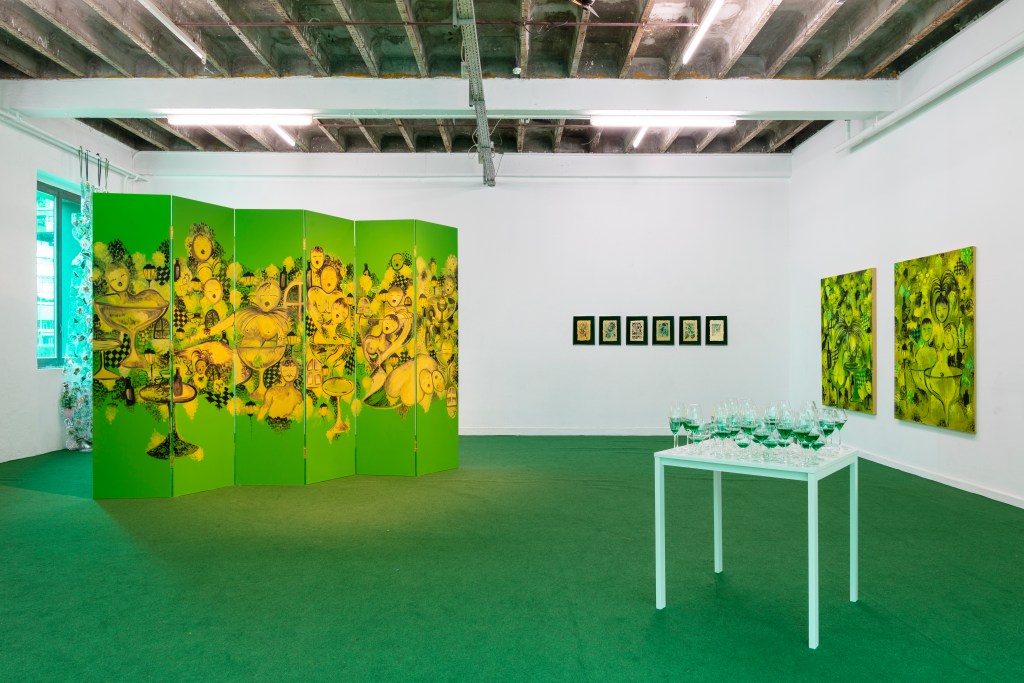
Image courtesy the artist and Forde Gallery, Geneva
Janine Iversen: wiming Press Release
Rien ne va plus. No more bets, you take the hand you’re dealt. The repurposed deck from the Times Square psychic, the empty tarot, the magician’s trick, the gambler’s debt. Shuffled into one deck, it’s that same, slight gesture that shifts fate. The image appears, the subject disappears…
Full text
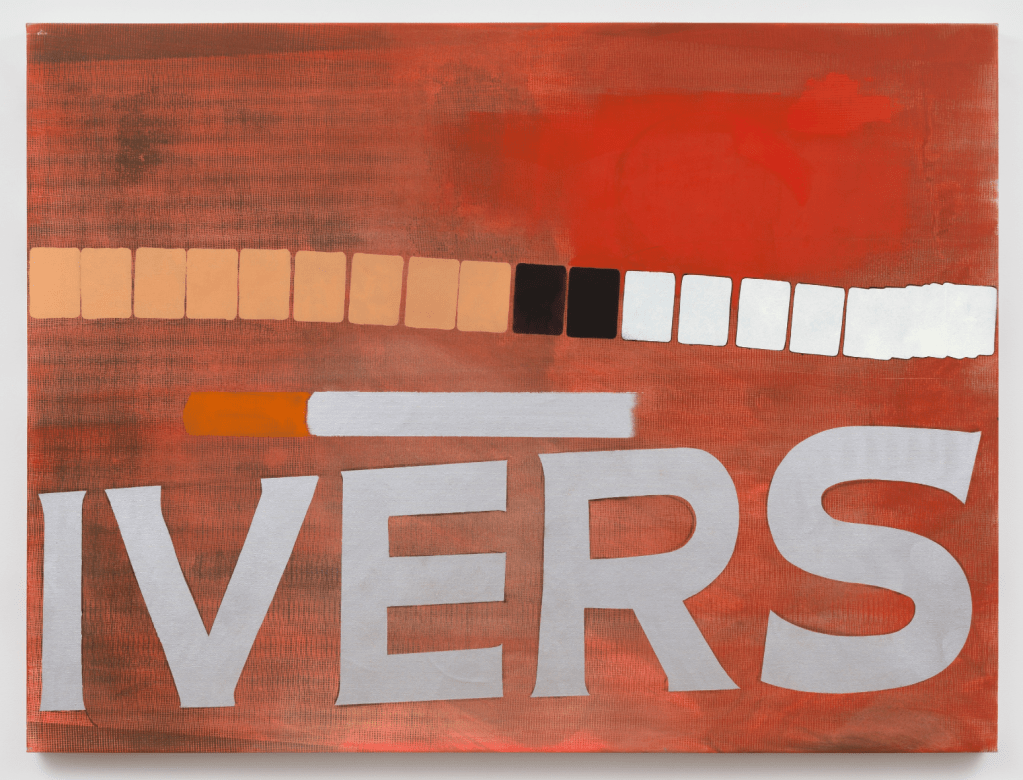
Image courtesy the artist and The Meeting, New York
2024
Violet Dennison: I Just Want a Little Credit! Press Release
Attention is a prelude for action. It’s scarce, both as currency and commodity. We consume at a pace as frenetic as that at which we forget, like that thought you started and then failed to write down. It comes out like a chant instead:
The more I make, the more I have, the better I am, the more I am…
R.D. Laing’s words rattle on repeat, casting a mantra across each disrupted panel, the woman-made and machine-made colliding to the point where each forfeits their origin story. Overlaid, disjointed, and distracted. Dennison takes the “blank canvas” and turns it into “blank screen”, the digital footprint and e-comm grid offering structure and order. In a world where everything unfurls without consequences, constraint can be comforting. Under the weight of a steel-toed boot, the one you haven’t purchased yet, you can click away infinitely, but there’s only so many options. Touchscreens rendered computer mouses mostly obsolete, though the target of our longing remains un-evolved, still evading any tactile grip…
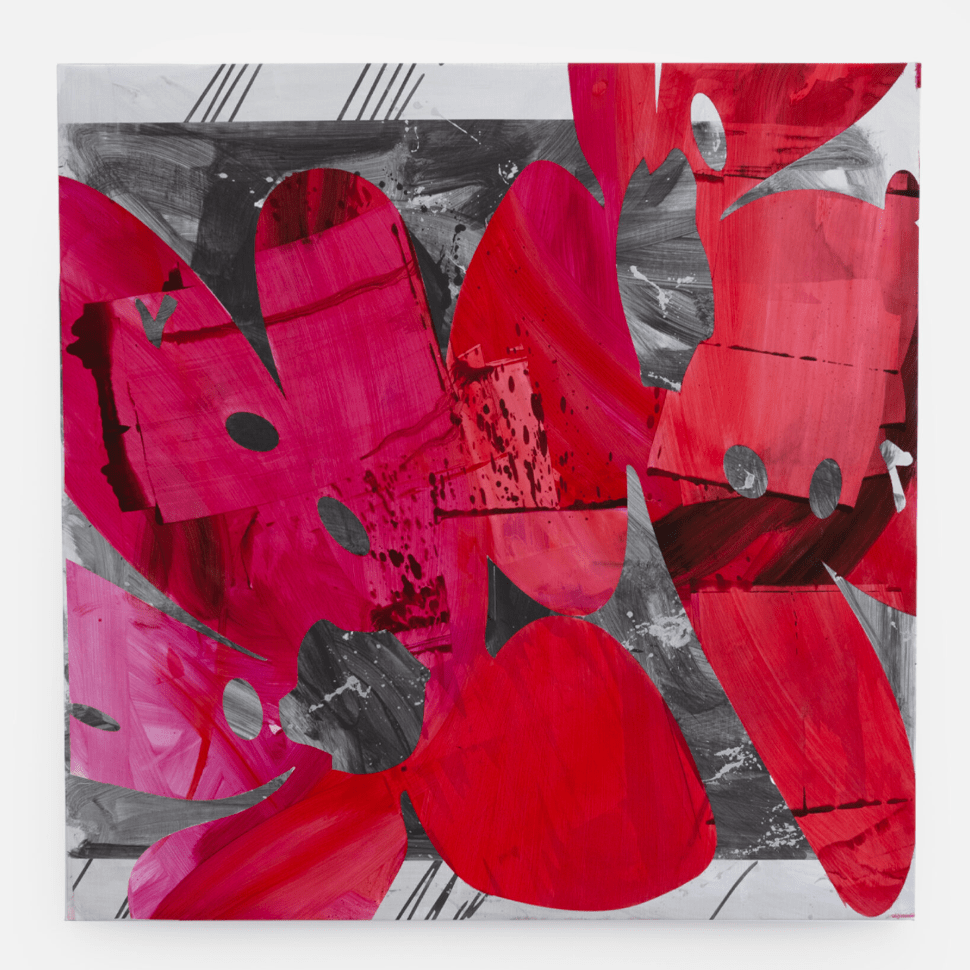
Violet Dennison
I just want a little credit! 1, 2024
india ink, graphite, acrylic, oil on linen. Image courtesy the artist and Ilenia, London.
TARWUK: Through a Theater of Threshold, essay in artist publication for the exhibition “Good night, Ernst Toller!”
One enters as if from above, with eyes downward. A diorama-like model reveals itself to an aerial view, a retelling of a performance that has already taken place, its miniature actors cloned and repeated, captured in poses like stop animation. The viewpoint is holistic, but the action’s apex, indiscernible.
On the metal stage: a sudden shift in scale. A vertiginous figure looms: it is totem and shell, worn from a past it would otherwise seem not to have experienced from its surrealistic composition. Directly across, two small observant heads stare back, lifting their gaze, one seated before the other, surrounded by windows folded like a dressing room screen. It is a barrier from the realm outside this delegated zone of performance, but still offers an unobstructed view of what lies beyond the precipice…
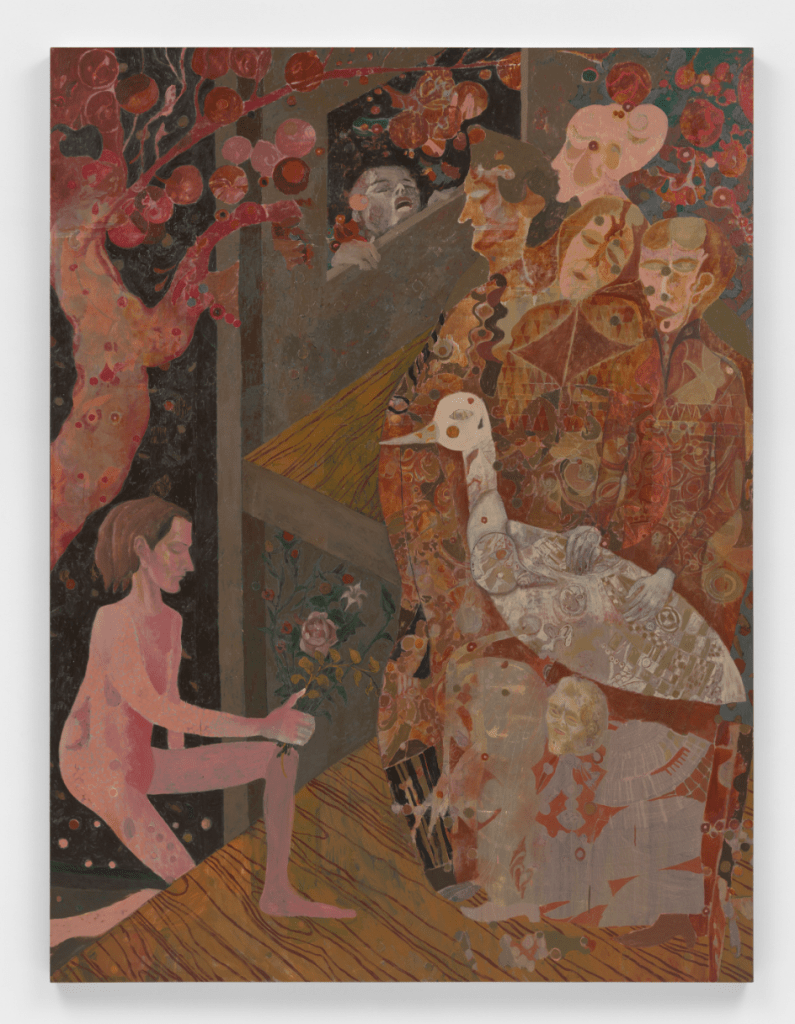
TARWUK, MRTISKLAAH_.rovivrus elos eht ;eert a ot dehsal dnuof erew uoY, 2024
Acrylic, oil, pastel and pencil on canvas. Image courtesy the artists and Matthew Brown
I Would Not Think To Touch The Sky With Two Arms Exhibition Text
Franz von Stuck charted a turbulent territory of the interior, mining its opposing forces to reveal a portrait of the human psyche. Whereas others looked to a Classical past as a wistful imagining of an ideal, von Stuck excavated humankind’s universal nature and basest desires, uncloaking an ever-present Mythology thinly veiled by modernity. The erotic and spiritual, humor and despair, Eros and Thanatos—the Freudian life and death drives—all collide in an undulating communion of sensuality and foreboding. Within his works, myth and allegory are underpinnings of the mind, rather than an escape from the confines of any particular era or the self. And within the world he created, the bounds of myth and life, life and art are indistinct from one another…
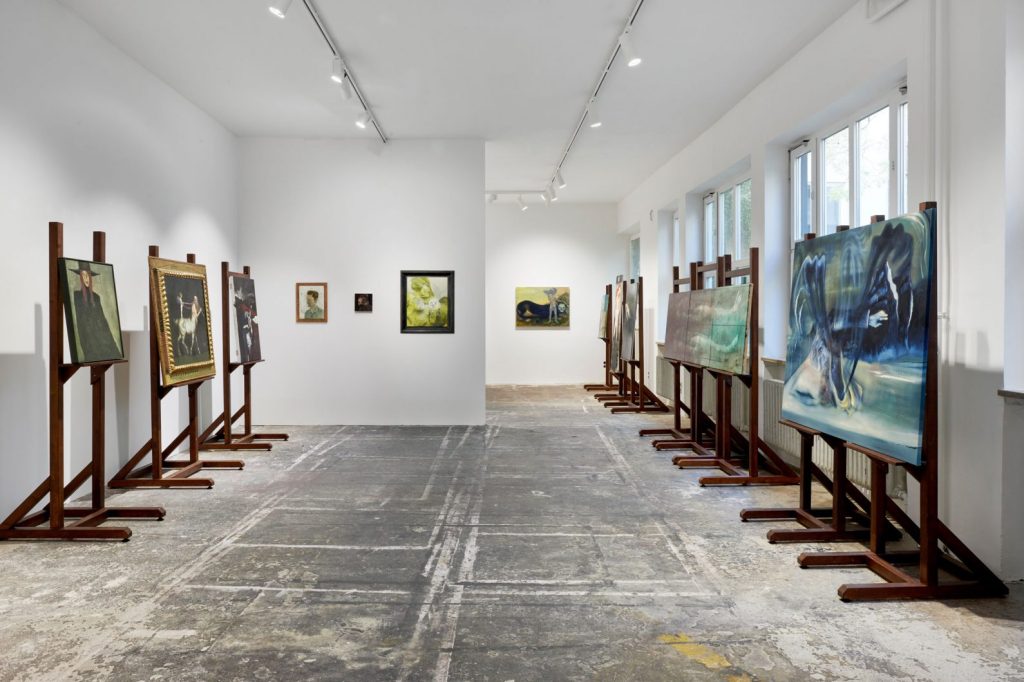
I Would Not Think To Touch The Sky With Two Arms, Installation view. Courtesy curator Andrew Dubow and Paulina Caspari, Munich.
2023
Phosphene, essay for Eve Sonneman “19 Watercolors”
It begins with the unassuming: a series of minuscule yellow dots, outlining what might unfold—but never exactly does. Marking where the paintbrush will strike the paper, the dots are the foundation, the unsung element of the composition, almost a secret between the artist and the paint. As a child in Chicago, long before she established herself as an artist in New York, Eve Sonneman’s Oma instructed her in this traditional wet-on-wet watercolor technique that she herself had learned in Germany. The process is a simple one: gingerly hinting where one might commit to placing the brush before the painting process begins—swift and confident, no hesitation possible, the final work erasing all traces of any premeditated thought…
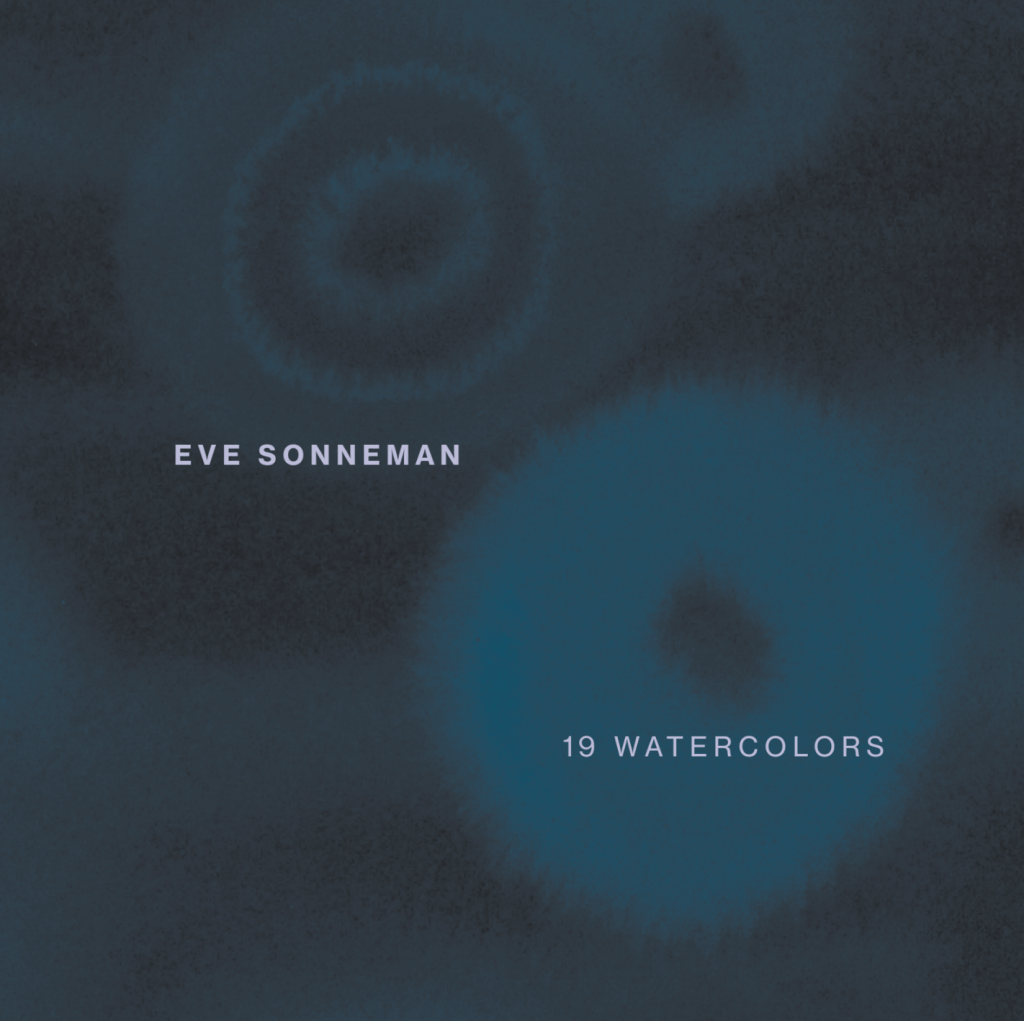
19 Watercolors by Eve Sonneman
Published and distributed by F
Publication Date: October 2022
8 x 8 inches, saddle stitched
32 pages, full color Risograph
+ cover, screenprinted jacket
Edition: 300 (numbered)
2022
Dead Souls, essay for F Magazine Issue 11: Intimacy
On that block, which anyone who resides in the city would take heed to sidestep, the hotel is usually reached by an ellipsis of a route, not unlike the sole way it can be avoided. The doors resist the motion of arrival. A perpetual wind envelops the building’s facade, recycled by speeding buses aiming for Port Authority, and perhaps, a gust that has escaped organically from the river, like a breath against all odds. The building was intended to be viewed from the outside-in.
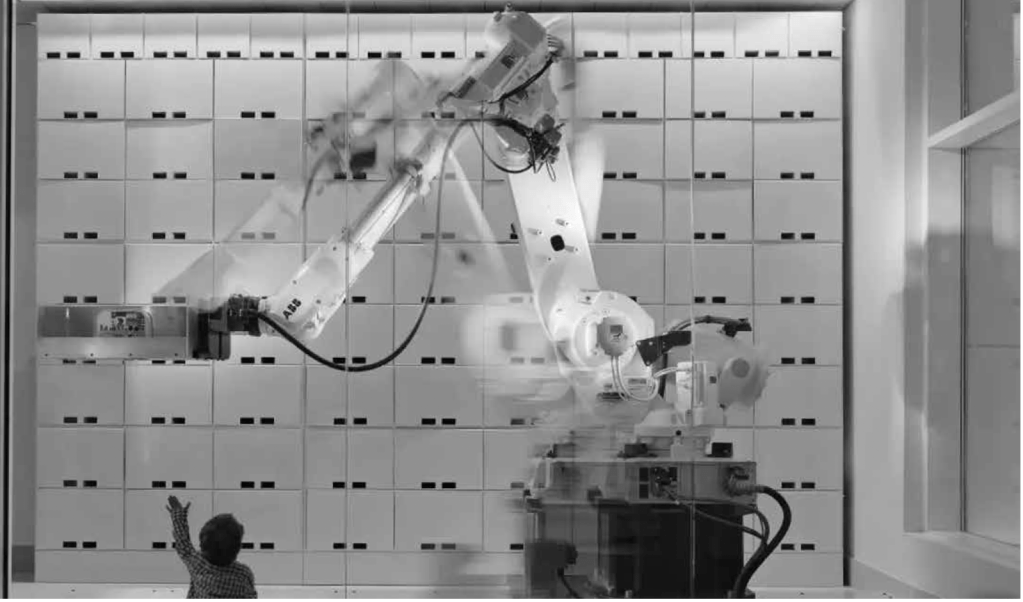
The hotel’s entrance level boasts some of the only ground-to-ceiling windows on the avenue, the rest of the surrounding buildings shuttered up or in, with makeshift boards and rusted gates. A white honeycombed facade above the glass panes, illuminated in purple light after dark, frames the spectacle of an
enormous mechanical arm, which plucks and returns luggage for arriving and departing guests. A gimmick of a greeting, void of human touch…
Rochelle Feinstein: You Again Press Release
Someone Else’s Hand, Someone Else’s Name, Something for Everyone. Gold joss paper on linen. It’s not real gold, but then again it’s not real currency. Its worth is only realized when it goes up in flames. Youthful stationery, monographed with a name you don’t respond to anymore. A note turned into a map, the inscribed words from an ex falling flatter than the surface, orienting a trajectory that always returns to this terrain—hitting a wall, looking for a way in. Or out. Someone Else’s Country…
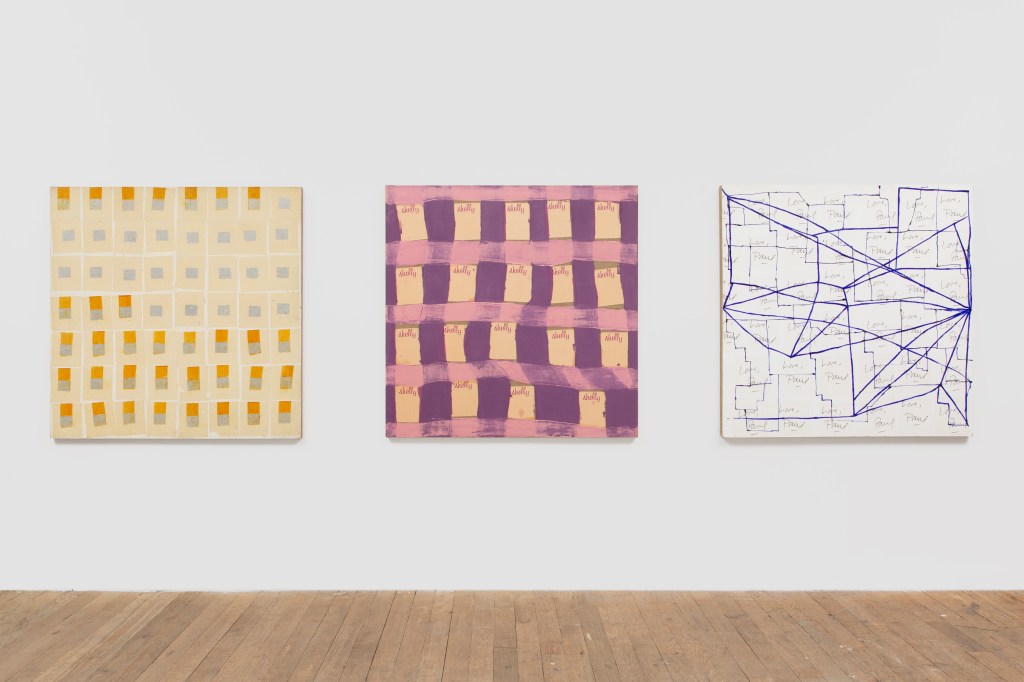
Rochelle Feinstein, Someone Else’s Hand, Someone Else’s Name, Something for Everyone, 1990–1993
Joss paper, notepaper, laser prints, oil on linen, Triptych, each: 42 × 42 in. (106.68 × 106.68 cm). Photo: Gregory Carideo. Image courtesy the artist and Bridget Donahue, NYC.
Kyoko Idetsu: I want to wear a warm sweater. Press Release
In English, we often refer to the domestic as a sphere, a space akin to the shape of the earth as a whole, tucked inside like a nesting doll, floating solitary and suspended, insulated. The habits and rituals repeat endlessly, even when we drag our feet, as though they are the ones pulling us along.
Repetition, maintenance, and care: these currents hem and weave within Idetsu’s paintings.
Realms touch without becoming enmeshed, sometimes carved out, divided on the canvas itself. A private glimpse of home is cradled inside a sweater; a woman cycles across a witnessed event and its imagined future repercussions, embodying an experience that is not fully hers. Tenderness and trauma are both banal, unfolding in amorphous scenes. One might be tempted to call the works vignettes. Idetsu’s unaffected, syncopated musings on each work evoke a parable, but one without moral resolution…
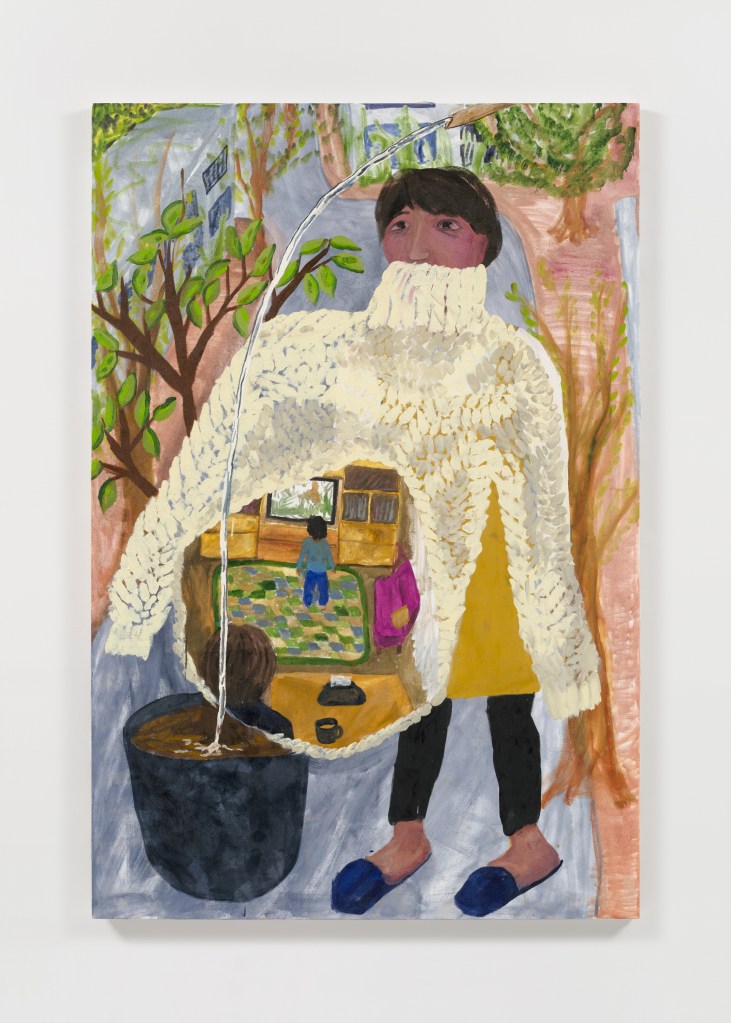
Kyoko Idetsu, I want to wear a warm sweater., 2022.
Oil on canvas 76 3/8 × 51 1/8 in. (193.99 × 129.86 cm). Photo: Pierre Le Hors. Image courtesy the artist and Bridget Donahue, NYC.
2021
A reflection on NOWORK’s Mimes, F PDF 013
WHENEVER FRIENDS COME TO NEW YORK CITY from other places, they always comment how peculiar it is that a city so developed has a rather rudimentary and crude way of discarding trash. It piles onto the street for collection, undisguised, as generous for the taking as it is unsightly and unhygienic. Too numerous to evade anonymity, our piles of trash amass similarly, although the detritus is perhaps the best quotidian archive of individual lives.
When Tuomas’ father, Erkki-Pekka, was alive, he accumulated discarded
materials. His studio was comprised of salvaged objects. He made a vacuum
form mold machine from an abortion pump. Articles and handouts became
xeroxed clippings and ephemera sorted into folders.
The significance of these materials in the context of Pekka’s practice
became reliant on their second life—a reuse, the possibility for transformation. Only after Pekka’s sudden passing in 2001 did the existence of these folders, some of which form the basis of Mimes, come to be known..
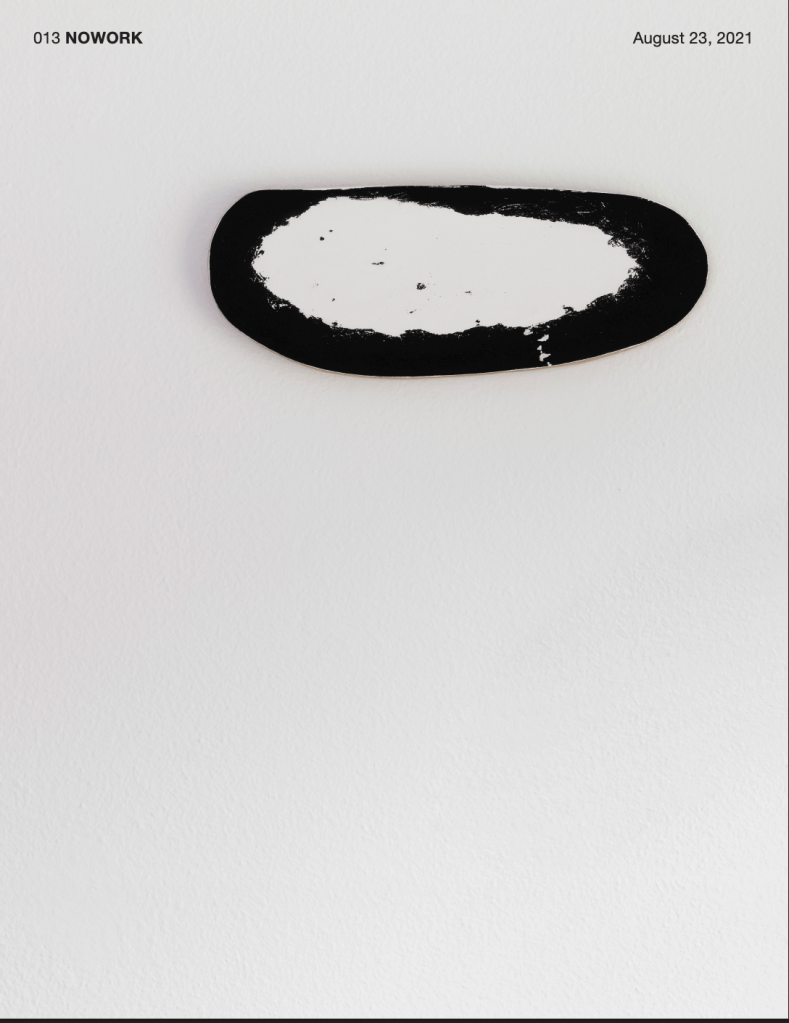
NOWORK, One, 2021.
Black gesso and vinyl spackling on wood. 5.25 x 13.5 inches (13.335 x 34.29 cm). Image courtesy the artists and F, Houston.
Nothing New Under the Sun, essay commissioned for group exhibition at Fabrikken, Copenhagen
The line between memory and history is as unreliable as one might expect.
Whether in the confines of our mind, or within the bias of consensus, there is
always more eclipsed than exposed. The past is what we recall, but history
is what we agree has happened.
My eyes scan Anna’s cyanotypes and there is a vast richness of familiarity.
It’s the fact that the blue envelops you before your eyes can penetrate it,
reminding me of the sea of my childhood, although I know little about the
photographic technique, despite her explaining it to me in person one evening in Helsinki. It’s somewhat the reverse of Anna’s own story in which she first saw sand dunes during a family trip off Denmark’s western coast. Her father explained to Anna how they were formed. Anna does not remember the words, but each time she sees the sand formations, she is deeply convinced that she understands the phenomenon behind what she is looking at.
I cannot locate my earliest childhood memory as a singular contained
entity, but rather as slivers of moments that surface like a light that waxes
and wanes, together skimming upon an early nascent period, impressionistic,
banal. One was an encounter with the thorn of a rose—I watched my finger
turn from flesh to crimson red, unaware of the pain, instead enthralled by
the pooling of blood after its prick, confounding a logical consequence with
alchemy…
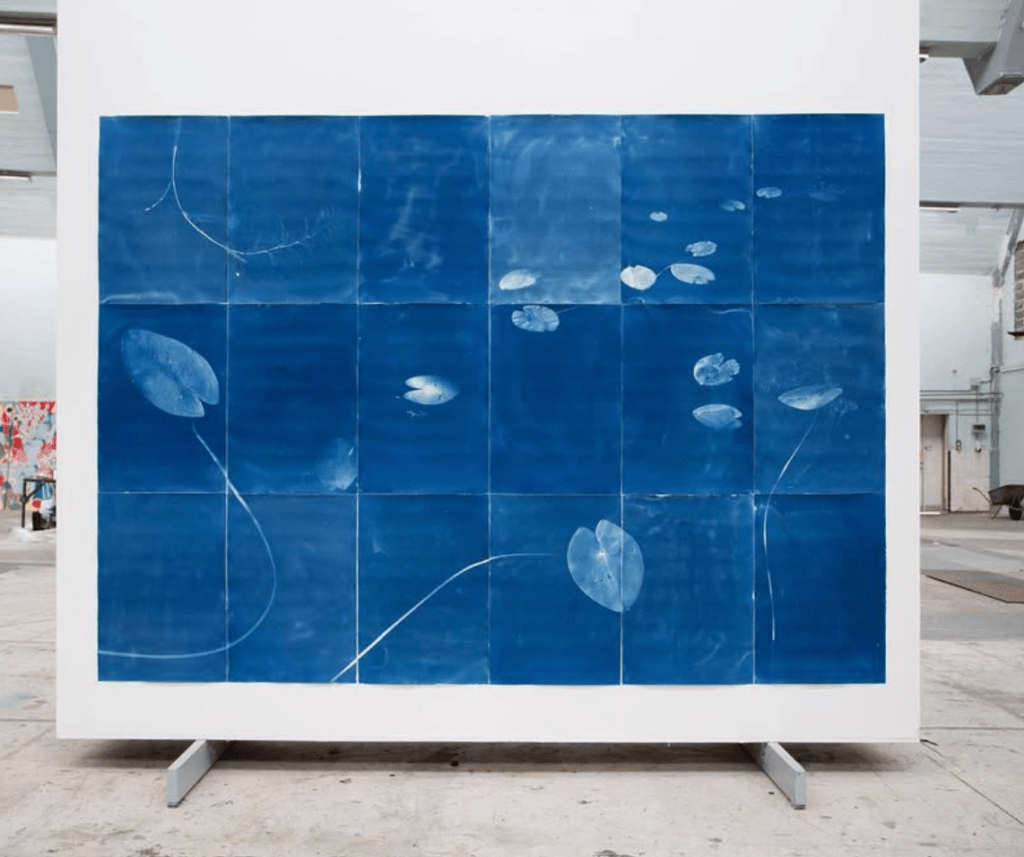
Installation view, Nothing New Under the Sun, Fabrikken, Copenhagen, Denmark. Artwork: Anna Niskanen: Vedestä nousee kasvi, 2021, 18 cyanotypes on paper. Image courtesy the artist.
2018
Peter Dreher: Seelenlandschaften Press Release
Dreher’s practice is one based on repetition and revisitation, a devotion to specific subject matter that unveils nuances and variations in the viewer’s perception. Perhaps most recognized for his series Tag um Tag guter Tag,
in which he painted the same empty glass for over forty years, Dreher’s work inhabits the terrain between observation and documentation, zen in its structure and unyielding in its desire for control. It is testament to his belief that every act of seeing, so deeply embedded with our own experiences, results in a new encounter each time with the same object–one that defies any expectation of objectivity such control might imply…
2017
The Imperfect Atlas, essay on Peter Funch, OSMOS Magazine Issue 11
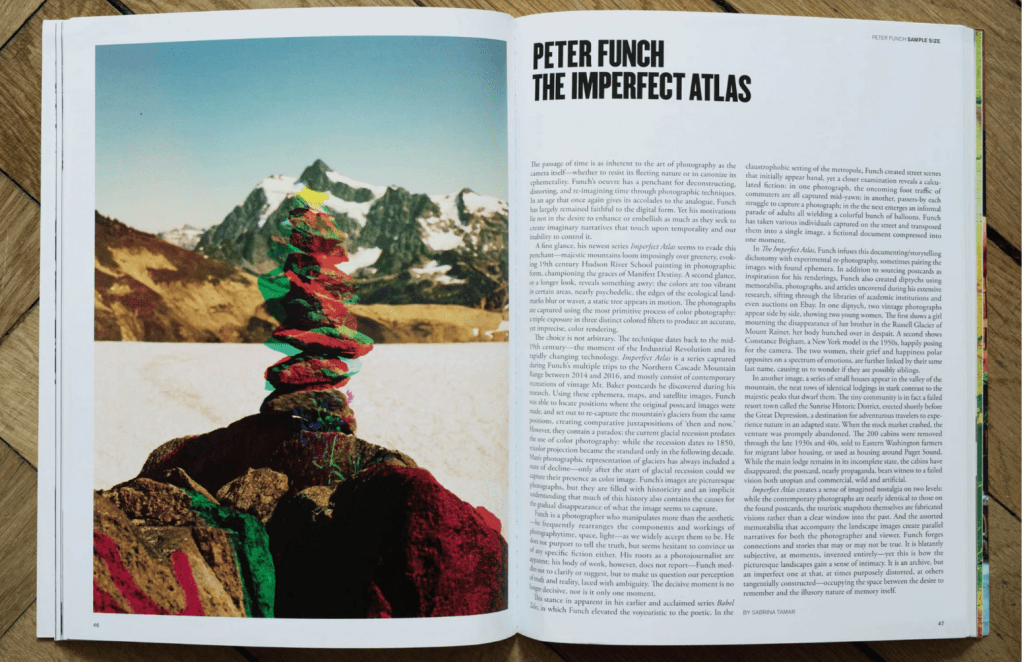
The passage of time is as inherent to the art of photography as the camera itself–whether to resist its fleeting nature or to canonize its ephemerality. Funch’s oeuvre has a penchant for deconstructing, distorting, and re-imagining time through photographic techniques.
In an age that once again give its accolades to the analogue, Funch has largely remained faithful to the digital form. Yet his motivations
lie not in the desire to enhance or embellish as much as they seek to create imaginary narratives that touch upon temporality and our
inability to control it.
At first glance, his newest series “Imperfect Atlas” seems to evade this penchant— in Hudson River School-esque landscapes majestic mountains loom imposingly over greenery, evoking a 19th century painting in photographic form, championing the graces of Manifest Destiny. A second glance, or a longer look, reveals something awry: the colors are too vibrant in certain areas, nearly psychedelic, the edges of the ecological landmarks blur or waver, a static tree appears in motion. The photographs are captured using the most primitive process of color photography: a triple exposure in three distinct colored filters to produce an accurate, yet imprecise, color rendering…
2016
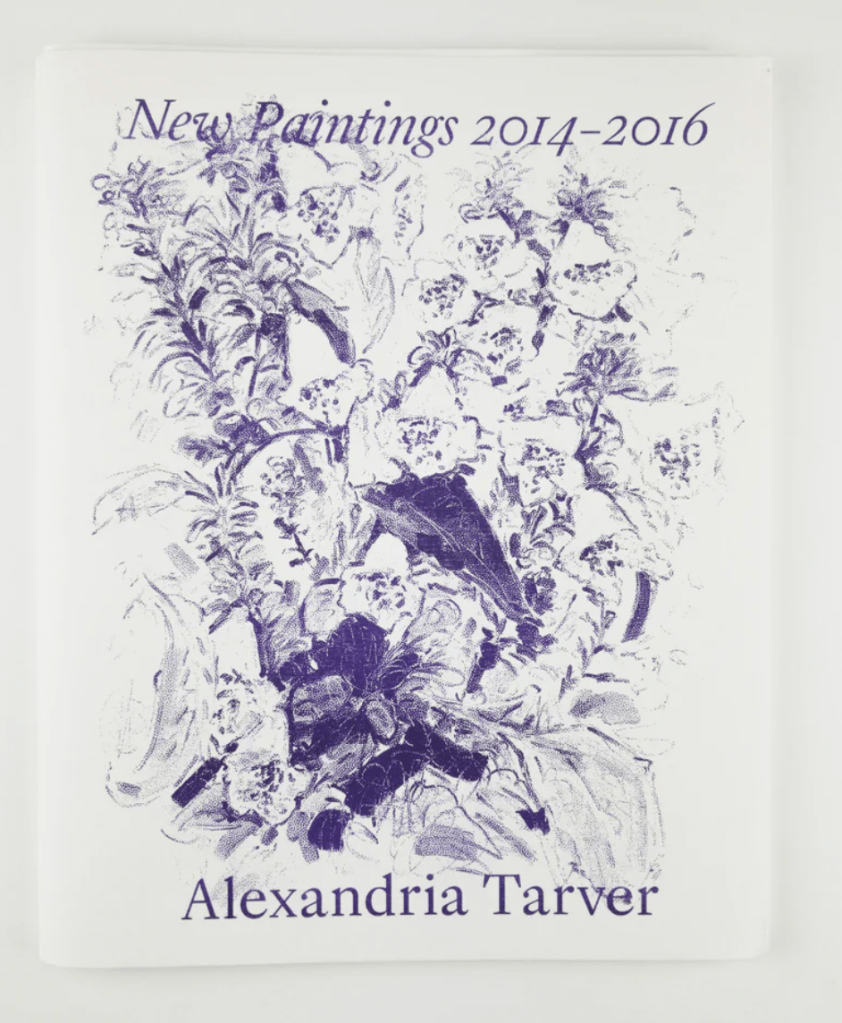
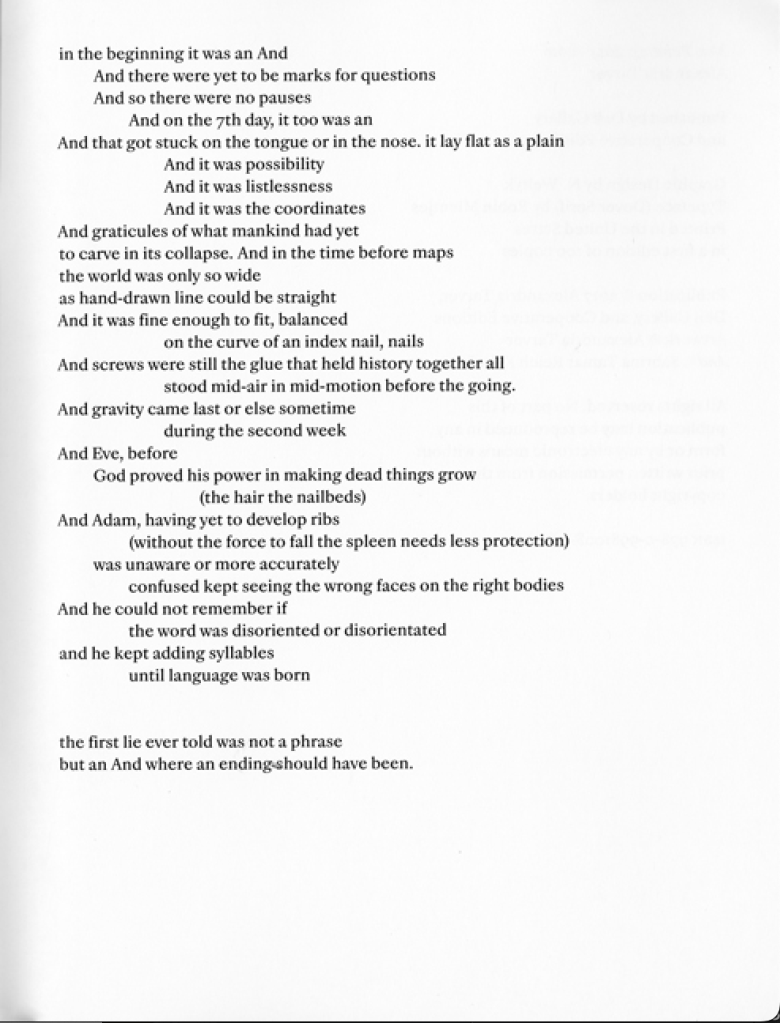
And (2013), poem featured in Alexandria Tarver’s monograph
 Sabrina Tamar